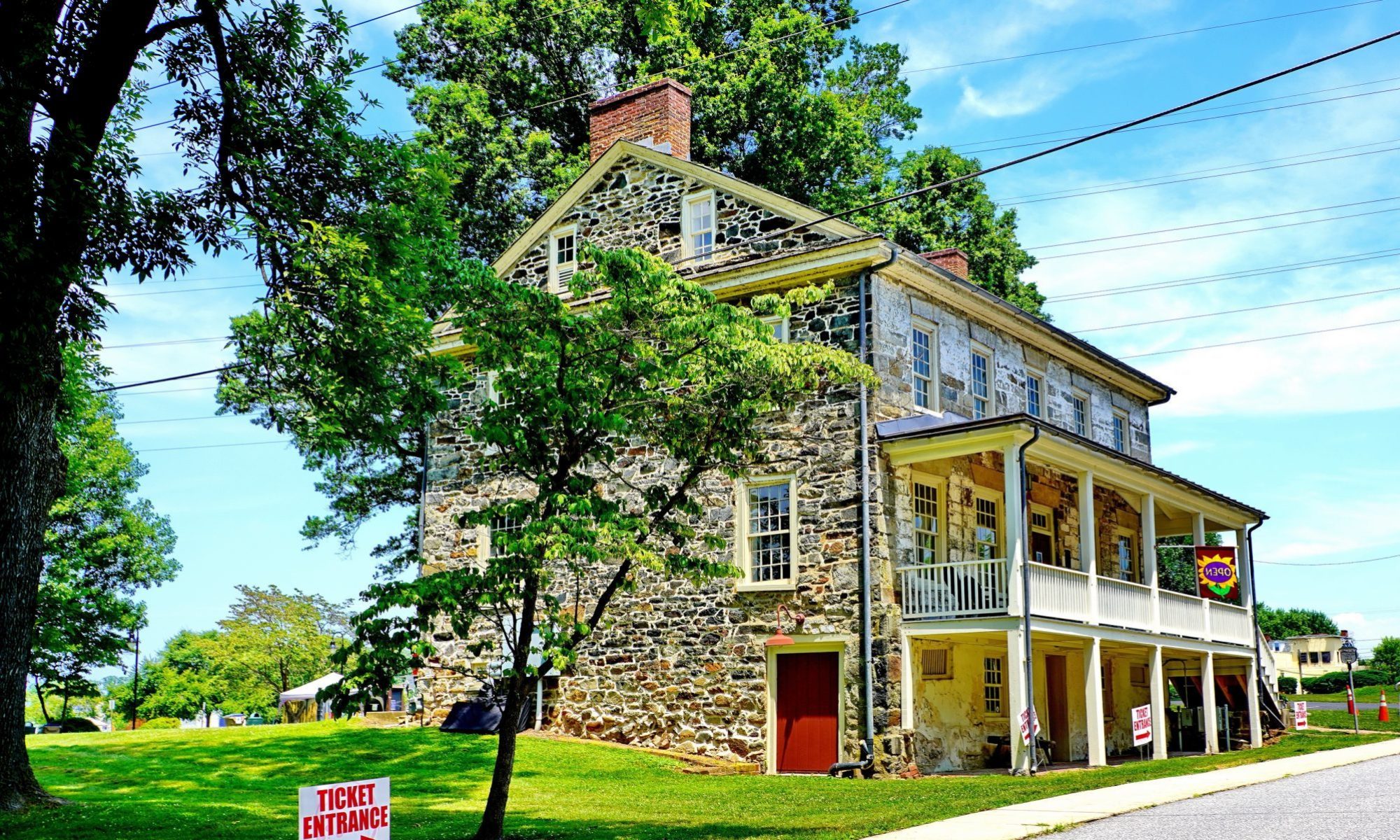
CECILTON — April 22, 2024—The National Park Service announced Monday that Union Bethel African Methodist Episcopal (AME) Church has been officially designated a National Network to Freedom site. This prestigious recognition celebrates the church’s significant connections to the Underground Railroad, symbolizing a beacon of hope and refuge for countless individuals seeking freedom and justice during the antebellum era.
Union Bethel AME Church in 2023.
Today’s church bears direct witness to its roots, which are traced back to the 1850s. In that tumultuous period, “Uncle Perry Hinson” ” built a small house of worship on the outskirts of Cecilton amidst the woods. As the only place where Black people could gather locally, faith and kinship aided freedom seekers and resistance, the modest sanctuary serving as a refuge for worship, education, fellowship, and the pursuit of equality.
Bishop Levi Coppin, born in 1848, grew up in this faith community. His mother ran a clandestine school to teach enslaved people to read and write, empowering them with literacy and knowledge.
Union Bethel AME Chuch stands among 19 newly recognized sites spanning ten states, all contributing to the history of resistance against enslavement. The Network to Freedom program is dedicated to honoring, preserving, and sharing these stories of courage and determination.
The designation process for National Network to Freedom sites involves a rigorous semi-annual nomination and review process. Through this selective assessment, each site’s historical ties to the Underground Railroad are meticulously authenticated and celebrated, ensuring that their significance is duly recognized and honored.
A wealthy industrialist and investor, James Bell, moved to Cecil County sometime around 1857 and established his winter residence here. He wanted to escape the severe winters of the north, and, according to the Midland Journal newspaper, “Conowingo struck his fancy.”
A 2018 photo of the summer home built by James Bell at Conowingo
There he purchased property immediately above the village, which is now known as Bell Manor. Wm. E. Porter had owned the land and he “was very glad to get rid of it as it was something of a wilderness and required a mint of money to make it look like civilized country,” the paper added. Bell turned it into one of the nicest spots in the county, his family spending the winter months here.
Bell was wealthy, newspapers remarked, “being credited with several million.” He was an exporter, particularly of cotton, and during the Civil War, made a great deal of money.
Locally, he was a major stockholder in the Conowingo Bridge Company and was involved in other enterprises in the village. James Bell died suddenly in May 1897 at his summer residence, Livingston Manor, near Hudson, Columbia County, New York, at 83.
Stock certificate for the Conowingo Bridge Company. James Bell was the president (Source: Hosanna School Museum)
Built around the the1860s, Bell Manor is a fine property on a high hill overlooking the Susquehanna and the old Village of Conowingo. The center of the large tract is the Bell Mansion, which the Girl Scouts of Central Maryland now own. This historic estate has seen many uses over the generations.
The Philadelphia Electric Convalescent Home in Conowingo — Now Bell Manor.
James C. Bell, a wealthy New York banker and shipper, started purchasing property in the Conowingo area around 1857. Over a few years, he acquired about 1,000 acres in the 8th election district. Around the 1860s, he built his retirement home in this remote corner of Cecil County.
Following Bell’s sudden death in May 1897, the family started selling off parts of the property. The Conowingo Land Company acquired the largest portion in 1902. It eventually became the property of the Susquehanna Power Company.
As contractors struggled to erect the Dam, the power company used it as a hotel or residence for executives and senior managers at the massive project on the Susquehanna River.
However, once the work was completed, the company converted the mansion into a convalescent or rest home in 1929. Philadelphia Newspapers frequently mention families visiting recuperating patients at Bell Manor, sometimes referring to it as the “Conowingo Convalescent Home.” According to one source, the facility closed in 1952.
In 1961, the Bell Manor House was included in the purchase of 300 acres from the Philadelphia Electric Company by the Girl Scouts of Central Maryland, adding to the existing 300 acres already owned by the Girl Scouts at Camp Conowingo.
The Elkton & Middletown Railroad didn’t go far, and it didn’t go fast. But after Sid Bledsoe shared a 1960 photo showing a boxcar on the track, we decided to check out the old right-of-way to see if there were any surviving artifacts from the short line.
1960s photo shows a boxcar on the E & M Railroad. In the 1960s, the spur was used to haul goods to Elkton Supply. (Source: Sid Bledsoe)
Originally discussed in the 1870s, the plan was to serve as a cutoff between the main line in Elkton and the Delaware Railroad in Middletown. But plans lingered until 1894, and by December of that year, the road had been built from the main line to the Big Elk Creek, a distance of about 1/3 of a mile. The corporation spent about $75,000 on its right-of-way.
This short section of track served an industrial area along Big Elk Creek, with spurs into Singerly Pulp and Paper and the Scott Fertilizer.1
Although the route had been acquired south of the creek in the general direction of Chesapeake City, the company never extended construction beyond the creek. It was consolidated into the PB&W Railroad in 1916.
Walking this short line in 2015 with Sid Bledsoe, the grading is still obvious, and a few old rails remain in place. The tracks’ use for delivery to Elkton Supply (now American Home and Hardware) was discontinued in the 1970s.
The High Line (Autumn 2002) has a detailed article on the Elkton and Middletown Railroad Company by John Hall.
For additional photos of the E & M Railroad, see this album on Facebook.
A revised survey of the E & M shows the plan for the lne in Elkton (Source: Cecil County Land Records.
Endnotes
KENMORE – In 1977, the Singerly Fire Company opened a fire station at Singerly and Providence roads, and in the early planning, the Company referred to it as the Providence Station. That caused a majority of the residents in the area to petition the county commissioners, asking that the area at the corner be known as Kenmore rather than having it referred to as Providence Coroner, Providence, Andora, or Fair Hill. Thus, on Feb. 28, 1977, the commissioners officially designed this community as Kenmore.
The Kenmore name had been around for decades. In the 1920s, the northeastern corner of the County needed a modern high school to relieve overcrowding at Elkton and supplement the small one-room primary schools in the area. With the Board of Education developing plans for a facility, the Kenmore Papermill in Providence donated land at the corner of Providence and Singerly roads. The company mule barns had been located on this parcel, as mules were used to haul pulp from Elkton to Providence.
Members of the Kenmore Elementary School’s sixth grade wait at the Elkton Railroad Station for a train to New York City, where they had a full day of sightseeing planned in April 1965 (Source: Cecil Democrat, April 1965)
With plans coming together, 200 residents petitioned the Board of Education to change the name to Kenmore School since the company donated the land. In March 1924, the Board agreed, naming it Kenmore High School, the Cecil Democrat reported. The contract for the structure was awarded to H. Clay Phillips & Son of Middletown, Del.
The Kenmore School opened in February 1925, and the first class of seniors graduated in June 1925. The commencement was held at the Rock Presbyterian Church. Hazel Emma Ott gave the salutatory, Anna Menagh Castner read an essay, and Corrine Alphonza Patchell gave the valedictory. The Rev John P. Otis gave the address to the seven graduates, their families, and guests. The graduates were Corrine Alphonza Patchell, John Emory Mackey, Helen Beatrice Patchell, Hazel Emma Ott, Anna Mary Stewart, Anna Menagh Castner, and Sara Elizabeth Hathaway.
In 1939, Kenmore’s enrollment was changed to include pupils in first through 11th grades. An addition to the Kenmore School was constructed beginning May 11, 1954, and was opened in January 1955. This new addition was dedicated on March 27, 1955. In 1958, the school’s name was changed to Kenmore Elementary School for first through sixth grades, as the upper grades started attending Elkton High School.
When a funeral procession from Wilmington, Delaware, crossed over the Perryville and Havre de Grace Bridge in early spring 1923, the new owners, the Maryland State Roads Commission, charged $4.45 for the hearse and five automobiles to cross the span. On the return of the hearse and cars, the toll taker collected another $3.95 from the mourners.
James J. Doherty, Wilmington Undertaker (News Journal, March 17, 1923)
This caused James J. Doherty, the Delaware undertaker, to seek a refund from the State Roads Commission. Funeral Director Doherty asserted that an act of the 1867 legislature ordered that no turnpike, bridge, or ferry company should collect tolls upon carriages, other vehicles, or horses going to or returning from a funeral. The lawmakers added that if someone violated this rule, the fine was between fifty and one hundred dollars.
John N. Mackall, Chairman of the State Roads Commission, wrote to Attorney General Alexander Armstrong, seeking guidance on the matter. Armstrong provided an opinion, writing that when the statute was passed, toll roads, bridges, and ferries were owned by individuals or corporations. Moreover, the legislature did not intend for the state to be prosecuted for charging a funeral.1
The double-decker bridge at Havre de Grace, probably in the early 1920s. (Baltimore Sun, Jan 6, 1941)
When the legislature passed an act in 1922 permitting the acquisition of the Havre de Grace and Perryville Bridge, the new act contained no exception for funerals, so that took precedence over the 1867 statute. The State Roads Commission could charge whatever toll they determined. and the state wouldn’t fine itself, so the Commission didn’t have to return the money.
As a practical matter, the attorney general continued that while the act prescribed maximum limits for charges, it imposed no minimum restriction. Since it had been the policy of the state since 1867 to require these toll routes to refrain from making charges to funeral processions, the opinion noted that in the spirit of the earlier provision, which had met with public approval for so long be observed until there was further legislation on the subject.
Endnotes
Alexander Armstrong, “State Roads Commission, Funeral Procession Crossing Havre de Grace and Perryville Bridge Not Entitled to Toll, Exemption,” Report and Official Opinions of Attorney General, (Annapolis: AttorneyGeneral’s Office, 1923), 308-310.[↩]
One of the darkest, cold cases in Cecil County history unfolded on a tranquil April night in 1891. The scene was a rural home along the road from Rising Sun to Conowingo, where intruders shattered the silence while J. Granville Richards and his family peacefully slept.
In the calm of that spring night, a noise stirred Jennie, his wife. She woke her husband, alerting him to an intruder in their bedroom. Richards seized a nearby pistol and called out, “Who’s there? Speak, or I’ll shoot!” With that, a gunshot rang out from the foot of the bed, and Jennie fell back on her pillow, a bullet penetrating her brain.
As the assailant fled, Richards pursued, encountering a figure in the hallway whom he thought might be his oldest son coming from his room. “Willie, is that you?” he called out, only to be attacked by a ruffian. Then a desperate tussle ensued, the house invader putting a bullet in his abdomen and then striking him with a heavy piece of iron. This caused the homeowner to tumble down the stairway, where he was shot again. The commotion roused other family members, prompting Richards’ two oldest sons to rush to the first floor.
Mrs. J. Granville Richards, a sketch from the Kokomo (MI) Gazette Tribune.(Kokomoz Gazette-Tribune, “Killed by Burglars,” May 2, 1891))
The boys, Willie, 17, and Harry, 15, helped their father back up the stairs, where they found their mother unconscious, in a dying condition on the bed, her “lifeblood pouring from a large gaping head wound.” Miraculously, their six-year-old brother, nestled between the parents, remained unharmed. The older boys were sent to get medical assistance and alert the neighbors. 2
News of the disturbance reached Rising Sun three miles west of the house around 2 a.m., prompting Dr. Turner and Dr. Crothers to rush to the residence. They found an appalling sight when they reached the home. Mrs. Richard was lying unconscious with a bullet hole behind the ear, and Mr. Richards was wounded with two bullet holes in his body, the projectiles having passed entirely through him. The four children clung to each other, weeping over their stricken parents.
Although Jennie never spoke another word, she lingered for almost five hours. Even though there was nothing more that could be done medically, Dr. Turner remained by her side until death eased her suffering. It was around 6 o’clock in the morning, shortly after daybreak, when she took her last breath.
The Cecil Whig said the Richards’ homestead was three miles from Rising Sun on the old Post Road to Conowingo, “almost under the shadow of the famous Richards Oak, a venerable landmark in that section” on the hilltop above Porter’s Grove. A Wilmington newspaper described it as an old stone structure about two and a half stories high, with the nearest home about a quarter of a mile away. This is a photo of a property across from Spready Oak.
Hunting for the Murder Suspects
The gruesome murder stirred a frenzy of activity on farms and in nearby villages as people flocked to the scene. With the first light of day, citizens set out to hunt down the killers, the neighbors organizing search parties while Cecil County’s late 19th-century criminal justice system geared up to join the effort to capture the fugitives. Although they scoured the countryside, the perpetrators had vanished into the night, leaving little or no clues to trace them.
Telegrams describing the killers flashed out on the wires to nearby points, instructing authorities to look out for the killers. But, in the deep midnight darkness of the house, Richards could only state that they were young white men from 20 to 25 years of age, both of whom wore light-colored overcoats. This put city police authorities on the case as they were on the lookout. The perpetrators of this horror on an innocent family took with them about $100, two watches, some silverware, and several railroad bonds.3
Grimmer telegraph bulletins followed as details became available. These spread the horrendous story to every city and town in the country, and reporters from daily papers and city detectives rushed from Baltimore and Philadelphia by special trains. This growing force of private investigators, railroad detectives, county law enforcement officials, and neighbors mounted a systematic manhunt. Also, city pawnshops received alerts to look out for the stolen property. But it was thought that by this time, the killers, cloaked in darkness, had put many miles between them and the scene of their crime.
Later that Monday morning, Joseph T. Richards, Assistant Chief Engineer of the Pennsylvania Railroad and Granville’s brother, arrived in Rising Sun with Railroad Detective Ottey and a force of assistant officers on a special train from Philadelphia. Captain William B. Lyon of the firm of West, Lyon & Smith came from Baltimore, while State’s Attorney William S. Evans and Sheriff J Albert Boyd arrived from Elkton. County Constables J. C. Hindman and John A. Richie were already there.
The State’s Attorney and Sheriff dedicated the entire day to working up the case. But, the villains left few clues by which they might be traced — outside of the ransacking of the house, the only visible clues to the direction taken by the murderers were footprints of two sizes, one made by a number 10 shoe and the other much smaller. The double tracks, headed in the direction of Colora, were traceable for about half a mile through the yard, an adjacent wheat field, and a plowed field before disappearing in sod.4 Besides this, a broken button and a piece of torn cloth were picked up. Deputy Sheriff Mackey made a Plaster of Paris impression of the footprints by the cellar door.5
Dr. Bram Arrested on Suspicion
A medical student was arrested.
As the first shock of the murder eased, people began to think of possible assailants. One they fingered was Doc. George Bram, 23, and a cry went up–“Where is Bram?” He had studied medicine under Dr. Crothers of Colora and went to Baltimore to attend medical school, but “soon became notorious as a body-snatcher and had to leave there,” it was alleged by The New York Times. 6
Bram was taken into custody at Rowlandsville by County Constable John A. Ritchie and Railroad Detective C. G. Ottey at about 11 p.m. Monday. While allowing him to get dressed, the young man’s pistol fell from his pocket — the detectives picked it up and found it to be a 32 caliber with three empty chambers. As soon as the officers handcuffed him, they telegraphed Media, PA, for a special train to convey the prisoner to the Elkton Jail.
The railroad sent orders to the night operator at Oxford, Robert Armstrong, to awaken Conductor Griffith and Engineer Brown. They were to make the run immediately, and at 2:34 a.m. Tuesday, their train started for Colora, arriving at 2:55 a.m. In a few minutes, Bram was speeding down the line toward Elkton. At 4:10 a.m. April 14, the prisoner was safe in the Sheriff’s keeping at the Elkton jail.
State’s Attorney Evans decided that the home of the elder Bram, with whom Doc stayed in Rowlandsville, should be searched. Thus, Deputy Sheriff Harvey Mackey, Railroad Detective Ottey, and several assistants returned on the special train “to follow up on the theory of Bram’s guilt and fasten the chain of evidence around him.” Back in Rowlandsville, the “tired, sleepy, and hungry deputy and detective got into a buggy and started on their errand for evidence.” Bram’s house was thoroughly searched that afternoon, but no evidence against him was found. While examining his trunk, they found a few old bones and dirty clothes but nothing to implicate the suspect.
When a Wilmington Morning News reporter visited the jail, they described Bram as “a well-dressed young man” who “seems to have been arrested solely upon his reputation.” He wore a neat black suit, a high collar, and a dark necktie. He also had a high silk hat.
On Tuesday night, with one man being held, the State’s Attorney received a telegram from the York PA Police Department, reporting the arrest of two men on suspicion of being connected with the Richards murder. Evans telegraphed, telling them to hold the men and to examine their clothing and find whether a light concave button had been recently broken from the breast of one of them. The answer came back that one of the coats had a freshly broken button.
Mr. Evans then dispatched Railroad Detective Ottey with a brother of Mr. Richards to York to settle the question on the button and a piece of cloth found on the fence gate. On Thursday, Ottey sent word that there was nothing to this connection.7
The Coroner’s Inquest
On Wednesday, Cecil County’s death investigator, Coroner Perry Litzenberg, left Elkton at about 9 a.m. and drove to the scene so he could get to work on the case.8 When the legal proceeding was called about 1 p.m. to hold an inquest over the remains of L. Jennie Richards and investigate the facts about her death, he was assisted by the State’s Attorney Evans and Newman Davis, stenographer to the State’s Attorney.
Since the day was warm and the house was “crowded with women making ready for the funeral,” Litzenberg decided to carry out the hearing on the front porch. ”In the center of the porch was an old table, at which sat the coroner and the stenographer. Around the table stood the jury with the State’s Attorney.9
The Morning News published a sketch of the Richards’ house. 10.
After swearing in the jurymen, the panel visited the room where the tragedy unfolded and was shown the presumed position of the intruder when he fired the fatal shot, the location of the bed, and the hole in the wall from Richard’s return fire.
The jurors, having thus been acquainted with the relative positions of the parties to the terrible affair, were taken into the room occupied by Mr. Richards to hear this testimony: “The presence of more than a dozen serious-looking men in the room, bringing as it must have done the horrible scene once more before his eyes with an unnerving realization that their errand was to inquire into the manner of the death of his wife, naturally shook his composure. But upon a few reassuring words, he was ready to be sworn,” the Cecil Democrat remarked.
Eight people slept in the house that Sunday night, so the jurymen moved to another room to interview more witnesses. William, the oldest son, testified that he took his gun and, accompanied by one of the brothers, ran across to the nearest house about a quarter of a mile away, that of Mr. Reynolds, as he sounded the alarm.
This concluded the testimony of the medical men, and the jury passed into the parlor to examine the body. The dead woman was lying on an improvised trestle, covered with a sheet that was stained with blood.
Finally, the coroner conducted the jurymen over the route followed by the thieves. They were shown the ladder leaning against a window, the cellar door, which was forced open by a crowbar, and the drawers that had been forced open with by a hatchet, along with other evidence of the burglary.
Having viewed the body, inspected the murder scene, and interviewed witnesses, the jury of farmers, newspaper reporters, and Rising Sun businessmen consulted for a few minutes before returning the verdict: We “do say that the said L. Jennie Richards came to her death on Monday morning, April 13, 1891, at the residence of her husband J. Granville Richards in the sixth election district of Cecil County aforesaid from the effects of a pistol ball that entered the brain, fired by the hand of some person to the jury unknown.”11
With the death investigation completed, the efforts to run down the murders continued without abatement on the part of the officers and neighbors, but there were few encouraging developments.
Elusive Search Continued
The excitement over the murder only increased as the days passed. With news of the tragedy spreading into remote parts of northern Cecil County, more people flocked in from all sides until, on Wednesday (April 15), there was a continuous stream of visitors along Porter’s Bridge Road. Little work of any kind was carried on in the vicinity. Farmers left their plows and mechanics their workshops and benches, and “even the women gathered together in small knots to discuss the details of the horrible event,” the Philadelphia Times observed. Many older inhabitants had taken unusual precautions in fastening their doors in this quiet neighborhood.12
Since a constant stream of reporters and detectives from Baltimore and Philadelphia occupied Rising Sun, the local telegraph agents were kept up three nights dispatching messages over the wires to the cities and Elkton.13
On Sunday, April 19, Sheriff Boyd and Deputy Mackey got on the tracks of Frank Ferguson as his departure from the Porter’s Grove area shortly after the horrible occurrence directed suspicion toward him. The lawmen, accompanied by a New Castle County Constable, located Ferguson outside Newark, and the Delaware Officer brought him as far as the state line. There, he was handed over to the Maryland sheriff. The detailed facts upon which this man was held were known only to the officers, the Cecil Whig reported, and the new detainee was soon released.14
The next day (Monday, April 20), Boyd came back up from Elkton for the “purpose of making more arrests in the 8th district of parties who bear a bad reputation and live without visible means of support.”15. The unimaginable crime kept the entire two-man sheriff’s office riding night and day, pursuing “every clue, no matter how slight, until it proved worthless,” newsmen remarked. But citizens thought they were “as far away from the real criminal as ever,” according to the Cecil Democrat16
Meanwhile, after spending ten days in the Cecil County Jail on suspicion, Doc. Bram was given his release from custody, the efforts to prove that he was implicated in the affair proving a failure. Baltimore officers had determined that he had been in the city when the crime occurred.
With the investigation yielding no viable suspects, the county commissioners offered a reward of $1,000 for the arrest and conviction of the perpetrators.17 This monetary incentive prompted private detectives to intensify their efforts in every direction to apprehend the criminals.
However, as the spring days passed, the mystery surrounding the murder seemed as elusive as ever, with no resolution in sight. A Philadelphia paper remarked, “The work upon the case formed an interesting chapter in police annals, as numberless clues have been run out only to find the wrong man suspected. . . . Other suspects were rounded up, but after sifting the stories, nothing amounted to them.”
Eventually, the Pinkerton Detective Agency took over the case, dedicating months to following leads. Within a few weeks, two men – one in York and one in Philadelphia – were arrested on suspicion of being the killers. The Pinkerton agents had shadowed these men. But once again, the case failed to progress beyond the preliminary hearing due to thin evidence. Over the following years, periodic tips led to more arrests in Oxford, Rochester, NY, and Philadelphia, PA, but none led to an indictment. Speculation arose that the detectives were trying to grab someone and make it stick to get the reward.
In March 1892, the grand jury recommended that further steps be taken to unravel the mystery. The county commissioners agreed, appropriating a sufficient sum to defray the expense of a more thorough probe while increasing the reward to $3,000.
The murderous home invasion, horrible in its character and unnerving in its detail in the dark Cecil County countryside, was on people’s minds for years. It was hard to forget the “cool deliberate shooting of an innocent, harmless mother as she lay in bed by the side of her child . . .. This caused many to ask who was safe?” But no one was brought to trial despite the tireless work of the entire Cecil County criminal justice system, railroad detectives, and many private sleuths, including the Pinkerton Agency. The Sheriff, one deputy, part-time constables in the outlying areas, the State’s attorney, and the coroner comprised the entire county law enforcement force.
As the decades passed and one generation gave way to another, the once vivid details of the cold-blooded crime began to blur. When J. Granville Richards, aged 70, passed away on January 14, 1922, the Midland Journal noted that no one had been prosecuted for the murder.18 The mystery of the Richards family murder haunted the community with the specter of an unresolved, cold-blooded crime for decades.
Midland Journal, “Burglary and Murder,” April 17, 1891[↩]
Farmer Mulligan first located the tracks. He secured a foot-rule accurately measuring the footsteps and slowly with great pain followed the tracks across the lawns, fields, and woods. Mulligan pegged each one with a short piece of word as he measured them. Once Sheriff Boyd and Detective Ottey took up the case, he alerted them to the trail, according to the Delaware Gazette and State Journalof April 16, 1891[↩]
Cecil Democrat, “The Richards Case,” April 28, 1891[↩]
Detective C. Edgar Ottey, who had been detailed by the Pennsylvania Railroad to work up Richard’s murder case, was presented with a handsome revolver by J. Granville Richards, the Philadelphia Inquirer reported on May 27, 1891[↩]
Memories are like lightning bugs – flickering into your mind when you least expect them. A muddy field, an approaching tropical storm, or a train derailment can bring them sharply back when you least expect them. But first, you need some background on how I found my way to the Cecil Whig more than 50 years ago.
My husband, Bob, and I were both newspaper junkies. After I finished college at Frostburg with an A.A. degree in English, my first job was at the (then) Salisbury Times.
I spent the first few months proofreading. Apparently, I did well and was shortly transferred to the newsroom. All men, of course, except me and the Woman’s Page editor. At first, my tasks were primarily writing headlines and doing re-writes, i.e., taking stories from another newspaper and re-writing those that pertained to the lower shore. Next, I transcribed articles from a microfilm machine for the “Look Back” series.
My First Front-Page Story
My first big front-page story was an interview with Miss America 1962, Maria Beale Fletcher. She had also been crowned Miss North Carolina in 1961. Another big story was an Interview in Chincoteague with Misty and her new foal Stormy, born March 11, 1962, during the infamous March Storm that inundated the shore. A photographer who went with me was Mel Toadvine, who later became the Editor.
Bob was working in the printing department reading linotype galleys (backwards) and running proofs for the proofreading team. We were married a year later and subsequently moved to Washington, DC, where he was able to finish his printing apprenticeship at Merkel Press (Sports Illustrated, and other magazines). After taking typing classes and shorthand in Salisbury, I transferred from reporter to secretary at the U. Md.
In 1968, we moved to Cecil County to a small 20-acre farm near Calvert. Now a certified printer, Bob joined the printing division at the News Journal. Happily, unemployed and with a toddler to chase. I turned my attention to horses and gardening. When our second child was six months old, it was time for me to get back to doing something that earned a paycheck. A classified ad for a proofreader at the Cecil Whig lured me in for an interview. But there, my plans changed. Instead of proofreading, the editor (Steve van Cleve, or was it Larry O’Hara?) squashed the proof room idea and offered me a job as the Woman’s Page editor.
Dot Clark With Misty of ChincoteagueMiss America in 1962
Twelve Years at the Cecil Whig
And so began my 12-year (1970-1982) stretch with the Cecil Whig. At that time, prospective brides filled out a form that then had to be typed into an article. “Social News” was handwritten by little old ladies all over the county. It wasn’t long before some of the ladies found out I lived near Calvert and saved so much time by just bringing them to my home on Sundays.
I hadn’t been there very long when a new editor was hired. Don Herring from a major newspaper in Indiana. He was a friend of Steve Van Cleve and arrived to take over when Steve moved on to California.
The Whig was published weekly on Wednesdays. Mondays were quite busy for all of us. Carty Dennison was the Sports Editor. Clark Samuel, who was the editor at the Cecil Democrat, brought in copy for his paper, which was printed at the Whig. Others I remember who worked in our department over the next few years (not all at the same time) were: Trudy Wilson, Beth and Neil Hannum, Barbara Halliday, Frank Fantini, Terri Peddicord. Paul McKnight, and Jeff Mezzatesta. Dick Frear was our photographer.
When Dick grabbed a job with Congressman Mills, he moved on and eventually got his dream job with National Geographic. He was replaced by Jim Cheeseman.
In addition to the Woman’s Page, I was also responsible on Mondays for calling funeral homes for obituaries and calling Union and Harford hospitals for new babies born.
Typing them into stories as well as sometimes a feature story for the Woman’s Page. By Wednesday, we collapsed in relief and eagerly read the paper front to back, looking for typos and to see what other members of our crew had been doing during the past week.
Rodeo Earl
An occasional visitor to the Whig was Rodeo Earl Smith. It was always exciting when someone recognized his old beat-up red pickup truck and people started to escape out the back and side door! It was a comical sight at the Whig. I don’t think a fire alarm would have had the same reaction. The reason for his visits was simply to talk to his friends.
Apparently, it was only the Big-Whigs he wanted to see (no pun intended). I don’t think he ever came into my office. And I won’t mention the names of those who disappeared. Ted Rue and Jerry Rutt (advertising) didn’t seem to mind his appearance. He didn’t particularly want to talk to any of the females in the office. And then he’d leave an hour or so later. And the miscreants would magically re-appear. I think they were hiding upstairs…..
Rodeo was a character around the county for many years. Usually dressed in his best cowboy outfit and a big hat, he was also known to visit the local “watering holes” around town on Friday nights. In fact, I was told (by a reliable source) that it was not unusual for him to have a police escort to see that he safely got to his home in Perryville after a night on the town. One car in front of him to lead the way, and another behind….. (so I was told).
Somewhere during those years, I also became responsible for weather-related stories. Storms, hurricanes, snow, and floods dropped into my lap. Suddenly, my stories were on the front page with a byline. I thought I had reached the pinnacle of my career – but I was wrong there was more to come.
Rodeo Earl (center) at the Sheriff’s Office in the early 1970s with Sheriff Tom Mogle (far left) and Maryland State Trooper Walt Wassamer (far right) (Source: Cheeseman Cecil Whig photo in the collection of the Historical Society of Cecil County)
Our office at the front of the building was U-shaped with two entrances next to each other. A brick wall separated two desks on one side and two on the other. The wall ended about 10 feet before the outside wall. We were continuously walking around from one side to the other. At some point in the early ’70s, Don popped over to my desk and said, “How would you like to be our police reporter?”
The Police Reporter
I’m sure I stared at him for several seconds before I said, “Sure, why not?” Now I had a real beat. We had sports covered, county government was a beat, and now I had my own. And then suddenly realized I was the first female to cover the police beat in the Whig’s history. My whole schedule changed. Woman’s Page stuff had to be done by Friday, except obits and births.
On Monday mornings I left from home and drove to the MSP barrack in North East. There were no press releases in those days. It didn’t take long for the sergeant on duty at the front desk to just hit the unlock button and let me into the offices. The last sergeant I remember was Frank Horseman. Betty Weed was the secretary. I always stopped first in the captain’s office for a quick overview of the past week. I don’t remember all of their names except Larry Rush and Murray Szep. From there, I freely walked downstairs to the criminal division for the latest on drug raids, homicides, etc.
The troopers down there were a select bunch of professional sleuths. Two of them I remember well were Bob Ventura and Fran Dixon. One day I admitted I didn’t have a clue what marijuana smelled like. One of them took me into the lab in a back room where a small dead plant was sitting on the counter and promptly set it aflame with his lighter. “There ya go,” he said. I guess that was my test for entry into the criminal division.
I was similarly initiated at the Cecil County Sheriff’s office, then in the old building on North Street. After being welcomed by Sheriff Sam duPont, he sent me upstairs to meet their criminal investigator – Bernie Johnson. Bernie didn’t waste any time to introduce me to criminal cases. After greetings and introductions, he walked across the room, opened a closet and threw me a pair of boxer shorts covered in dried blood. I caught it just as he asked, “What do you think of that?” And I said something like: “Looks like somebody needed a really big band-aid.” He burst out laughing and said, “You’re gonna be OK.”
At another time in my career, I entered the NE MSP barrack one morning. Sgt. Horseman smiled and unlocked the door and I walked downstairs to the criminal department, opened the door and faced a group of men in outlandish attire. Gold chains, tattoos, long dirty hair, and I turned right around and left. Then, just a few steps away, I heard laughter, and one of the men opened the door and ushered me safely back into the office. Turned out the motley crew were part of undercover troopers on the narcotics squad. They had a big laugh about my misunderstanding.
Somewhere along my history with MSP Barrack, I got an offer for a ride in their helicopter. I was just figuring out how to get aboard when they got an emergency call and my flight was cancelled. On another occasion, I rode with a trooper when they had just received the latest radar speed detectors.
I did bump into Larry Rush some months after he had retired. He was a “greeter” at Walmart. I almost didn’t recognize him. He had sprouted a handsome mustache! He admitted he had waited years to have one.
It wasn’t unusual for me to be sitting at my desk writing up a police story from my collection of notes and stop suddenly. Was that statement “on the record” or not? And I always called to be sure it was ok to print. Or not.
I also recall a Sunday when I was driving on 272 from the grocery store in North East and suddenly saw a blinking red light behind me. Now who in the heck would pull me over? They all knew my 1963 beige Buick. But this trooper I had never seen before. There I am attired in my old ragged red quilted barn coat and an “old lady” bandana tied under my chin. After showing my license and registration, he gave me a warning for doing 55 in a 50 mph zone.
On Monday, I made my usual first stop at the NE Barrack. Sgt. Horseman let me in and I stopped at the Captain’s desk to find out who had written me a warning the day before. And he burst out laughing. It could only have been their newest rookie sent to the barrack last week. I hope the poor guy didn’t get too much ribbing from his new flock of buddies.
While I didn’t visit the MSP Barrack on 1-95 very often, I did call them regularly. On one occasion, I got a telephone call from one of our readers asking why he hadn’t covered the terrible accident last week on 1-95. I was totally blank. How could I have missed that? I had talked to the sergeant at the barrack and was told all was quiet that week. I called them again to figure out how this accident was missed. The sergeant admitted to me that there had been an accident, but there were no injuries and certainly not a fatality.
What happened? The driver had lost control of the vehicle and on its first roll, the driver was thrown out of the car and landed on the embankment. From there he watched his car continue to roll down the highway over and over and finally came to rest on the shoulder. And then he had walked down to see what was left of the car. I did return that call to the person who had made the inquiry and explained what happened and why it wasn’t published.
Another regular Monday visit for news was the Elkton Police Department, located behind the City Building on North Street downtown. Tom McIntire was the chief of the department. And I fondly remember Willie May, Ray Murphy, Joe Zurolo and Marshal Purner. One of the memorable stories from them was when Zurolo fell and broke a leg chasing a suspect.
Photography
Photography was not on my list of duties. But there came a day when Don handed me a camera and sent me off to an accident at the intersection of Rt. 279 and Blueball Road. Cheeseman was not available. My expertise with a camera was a little Brownie. It’s OK, he said. Just look into that little window and push this button. That was my first lesson in how to operate a camera. The incident turned out to be a double fatal accident. I took a couple of shots of the damaged vehicles. But the most poignant photo I did not take. I couldn’t. It was one of the MSP troopers that I knew and he was holding a small bundle in his arms with tears in his eyes. He didn’t see me. And I turned away.
There were only three photographs that I keenly remember that were published during my years at the Whig. I don’t remember who took them. But one was a shot of an MSP trooper driving really slow along the shoulder of 273 – with a horse walking behind the car and a rope attached to the bumper. The second one I remember was probably taken by Cheeseman: An MSP car parked near the Courthouse with an Elkton Police Department ticket on the windshield. The third was a photo by Dick Frear. One of his most famous pictures was a butterfly sitting on an empty beer can. I was crushed when he told me that the butterfly in fact was a dead one that he had picked up and staged on the beer can.
Rosemary Culley
One of my best friends to be was Rosemary Culley. At the time, she was an emergency operator located in the basement of the county courthouse. She was widely known throughout the county when she had initially single-handedly dealt with the major airplane crash at the Turnquist Development on Delancy Road in 1963. That deadly crash was a few years before I met her. However, there was an event several years after that crash that was never published.
A woman who lived in that area came into the Whig one day and wanted to know why we had never published the story about the ghost in that development. She then told me her story: She claimed that several of the folks who lived there had seen the ghost of a little boy. She described him as about 5 years old. He had blonde hair and always seemed to be looking for his mother. She said she had seen him herself a few times, always at the top of her stairs and crying. Most of the homes in that area had been built on the site where the plane crashed.
Unfortunately, none of the witnesses who had seen that ghost wanted to be named publicly. And I had to tell her that without names to document their story, it could not be published. Rosemary and several others I asked later had not heard the story.
One of the many memorable events with Rosemary occurred at the “Housing” (Grand Opening) of the new firehouse on Singerly Road. After all the speeches were over, she came to me and said, “Come on. The crew is going to give us a ride in the snorkel.” What? I thought she meant the truck. But the ride turned out to be in the lift basket. And I’m scared to death of heights! But there we were with no turning back and a few minutes later we were high enough up to see the traffic on Route 40. All the whooping and hollering below quickly made us realize it was windy up there and we were both wearing skirts! I think we were “set up” for that hoist to the skies!
As I mentioned before, my old ’63 Buick was widely known by most police around the county. But it really came in handy for another local plane crash. It had happened about 4 a.m. in a wooded area on Middle Road. When I got to work, Don sent me up there to see what I could learn. I hadn’t even thought that other news media would be ahead of me. But there they were. All the area TV stations: Baltimore, Wilmington – all lined up and parked on the side of the narrow road. Fire police weren’t allowing anybody into the site. The road was blocked by yellow tape. They were all just sitting there – waiting. And then the fire policeman recognized my old unmarked Buick and waved me in! I’m sure all the news crews didn’t have a clue who I was – maybe a member of the family? I didn’t care what they thought. Another fire police member showed me to a parking spot. I could have hugged him – but didn’t. It was Tuesday. Our deadline day.
I could have walked to the crash site – but was told it was deep in the woods and muddy. But they were all talking about it – and I listened. The plane was upside down. A small plane and the two men had been identified as navy personnel. Both dead and hanging from their seat belts in the upside-down plane. The original theory was that they had been flying in the dark and somehow were flying upside down when the plane crashed – with no evidence they had even tried to avoid the crash.
Blissfully, I sailed back to the Whig, waving to all the reporters and camera crews as I went thru the long lines on both sides of /the road. The story was the top front-page headline when the Whig was run on the press Tuesday night and “on the streets” (as we say) on Wednesday morning. Don was ecstatic. The TV crews held back were too late for morning editions and what was published in evening papers had only the basic facts and apparently they had not been given the details that had freely been given to the local paper. Maybe by then they had figured out who that strange lady in the old car had been.
My Most Challenging Interview
My most challenging interview came unexpectantly and was never published. It was a quiet day in the newsroom with just Don and I working in the newsroom. A man walked into the Whig and told the receptionist he wanted to talk to the police reporter. She directed him to me and as he approached my desk introduced himself as Bruce Johnston. He wanted to tell me a story about our Sheriff Jack deWitt. According to him, deWitt had “set him up” for an encounter in Chester County. First of all, he complained the Sheriff had no business or authority in the state of Pennsylvania. He rambled on and I dutifully took notes. I knew his reputation, of course and my comments were basically: “Is that so?” “Really? I didn’t know that.” while scribbling on my notepad. Don had quietly positioned himself behind the wall that separated us and was listening intently but unseen by Johnston. He occasionally peeked around the wall to let me know he was there.
Johnston finally left, and I sat there stunned. Don flattered me, saying I handled the situation perfectly. I don’t remember when this interview occurred. But it was obviously before the numerous homicides that ended his criminal career.
Johnston was the leader of one of the most notorious gangs in the history of Pennsylvania. The gang formed in the 1960s and had a long history of daring thefts and calculated robberies. The gang split in 1978 after an altercation between them. Johnston’s career ended in 1978 with a shootout between the two sides that killed six people – including his son James. His son, Bruce Johnston Jr. survived the shootout and testified against his father Bruce, Sr. Johnston and two others were convicted for the murders and sentenced to six years for each of the victims and the attempted murder of his son, Bruce Jr. He died of liver cancer in 2002 in the Graterford Prison in Pennsylvania. There was even a movie released in 1986 about the Johnston Gang titled “At Close Range.”
Working With Don Herring
Working with Don for 12 years was never a dull moment. During the first few days of his newly appointed position, we learned that his antique typewriter was a hallmark of his newspaper days even before he arrived in Elkton from a busy major newspaper in Indiana. We laughed at it. For antique, it was. An old black upright with round keys and clacked away as he typed with two fingers. He was actually quite fast at his typing, and we soon just ignored it. I hope somehow that old machine has made its way into a history museum somewhere.
There were no computers in those days. No cell phones for instant communication. No cameras as part of those phones. We all had typewriters. Mine was an IBM Selectric. Even the thought of”voice” typing was unheard of. Our photographer, Jim Cheeseman, didn’t have any of the new fancy camera equipment. All of our photos were on film that he rolled by hand and developed in a darkroom where he also made our prints. Before police/fire scanners came along, we had monitors. A green box with an antenna sat on the window sill in our office. Later I also had one at home.
As for the paper on which we typed our stories – that paper came from the giant rolls of paper used on the printing press. When we got low on paper, one of the guys in the press room cut a huge stack of letter size paper from those rolls – cutting it with a piece of equipment that could only be called a guillotine with the finished stack 1-2 feet high.
I have memories of Don that are not in the history books and not important in any way. They have stuck in my mind only because they were comical. Don had a sarcastic sense of humor and those who knew him will probably remember. For instance:
One year he gave me a present for Christmas. It was a fully typed page of just commas. He gave it to me as a one-year supply and said I should be sure to use them more often.
We went together to a train derailment along Route 40 near Elkton. Unable to even get into the area with roadblocks everywhere, he parked his car on the shoulder of the highway. We could see the overturned train and he hopped out of his car and said,” Come on – We’ll just walk across this field.” Midway across the field, we sank into a nice, cold, wet patch of mud. “I’ll ruin my shoes!” I said. “It’s OK,” he said, “Come on – We can buy you a new pair of shoes.” (The train derailment was the end-result of a test run of a high speed train. All traffic on the tracks had been closed for the event and there were no injuries to the train crew.)
On another occasion, I was headed off to an event I don’t even remember when I discovered my dear old Buick wouldn’t start. I headed back into the office and Don said, “It’s ok. Take my car.” and handed me his keys. On my way out the door, he said. “Be careful where you park. It doesn’t go in reverse.”
I distinctly remember another day when he was getting ready to leave for a meeting. It was raining hard and he pulled on his raincoat. I said to him, “You can’t wear that. The hem in the back is hanging down.” He promptly took off the offending raincoat. Laid it on his desk and used his stapler to “fix” it. Then he donned the coat and left totally unperturbed by the event. I’m pretty sure that incident confirmed my lesson to ”think outside of the box.”
One of his favorite personal stories: While stationed in Korea during that war, he was excited to have been among a huge crowd of young military officers and recruits to see Marilyn Monroe in person on a mission to cheer the troops. With hundreds of whistles and shouts, the crowd was thrilled to see her. It was the highlight of his military service. And the only one he ever talked about.
Tropical Storm Agnes
One of the major events in my years at the Whig was Tropical Storm Agnes in 1972. There were photographers from everywhere converging on the lower Susquehanna. Cheeseman was already out there, and I decided to stay in the office and make lots and lots of phone calls.
One of the reports from the local fire marshal was that two finished tunnel tubes at Wiley Manufacturing had been towed out into the middle of the river and loaded with explosives. The reasoning behind this action was that IF the Conowingo Dam collapsed the massive flood that would follow could tear the tunnels loose from their moorings at Wiley and rage downriver. If that had occurred, they could have slammed into the 1-95 and route 40 bridges and perhaps even the CSX and Amtrak railroad bridges. But that, fortunately, didn’t happen. In the local towns along the river evacuations were underway. In Cecil and Harford County police, fire and rescue crews scrambled to stay ahead of the imminent danger. Rosemary Culley and her crew in the basement of the courthouse made announcements and calls for help throughout the day.
Don Herring (seated at desk), the editor at the Cecil Whig, with some of the reporters (Source: Cecil Whig)
Late in the afternoon, a spokesman at the North East MSP barrack told me the water level on the north side of the dam was being monitored continually. An unidentified expert (I assumed a state engineer) had estimated a specific maximum height at which the dam could likely fail. I don’t’ remember the exact height. At home that evening, I listened to the monitor as MSP regularly reported the water height. I dared not lay down and fall asleep. Finally, at 4 a.m. the dam report was within inches of the danger zone. I drove down to the NE Barrack and waited for news. Within the next hour the water height had slowed and then stopped rising. We all cheered at that moment when the announcement was made and I went home to catch some sleep before going into work.
During those years as a police reporter, I sometimes noticed a mild rift between the State Police and the Sheriff’s Office. It was never mentioned or discussed. I assumed that the situation had begun in the 1940s when families flocked to Cecil County for jobs at the huge Triumph Explosives site near Elkton. Several families had also followed William duPont from Virginia. But for hundreds of years even preceding the increase in population, the sheriff’s departments had been responsible for serving warrants and other court related duties, maintaining security, and the local jail. The sheriff deputies were directly accountable to the citizens and their locally elected sheriff.
In those southern states from where most of those new arrivals came, were accustomed to a different range of duties. When they needed emergency help or assistance, they had routinely called the Sheriff’s office. At that time State Police handled traffic accidents, homicides, and criminal activities. In Cecil County both units had duties and responsibilities that frequently overlapped.
Returning to Cecil County
On my return to Cecil County after 15 years in Wicomico County, I realized that relations had improved. MSP and sheriff’s vehicles are now often seen working together at local incidents.
Another new advantage I quickly discovered upon my return must be a blessing for fire and police reporters today. The fire companies now take their own photos at the site of fires and post them to their websites. Reporters today don’t have to freeze their fingers and toes on a dark night taking photos and comments while stepping over a web of fire hoses and gratefully huddle on the nice warm side of a fire truck.
Over the past 40 years, Don and I kept in touch mostly by the old-fashioned telephone. At some point, we started referring to the paper as the “Whiglet.” When he and his parrot (Moe) moved to Hurlock to be closer to family, we occasionally met at the Cambridge Diner for a quick get-together as Bob and I traveled back and forth from Wicomico to Cecil County. I still miss my dear friend.
When Pan American Flight 214 Crashed in Elkton, news media outlets rushed to get a flash out on the story first. In line with demonstrating the effectiveness of the AP at covering rapidly unfolding events, the global wire service had a weekly newsletter where editors spotlighted AP breaking news coverage, and it focused on the accident.
For the Dec. 4-10, 1963, issue, the AP Log wrote, “The speed and thoroughness with which the Associated Press” moved into and surrounded “a spot-break major news story through member cooperation, stringer sources, and staff mobilization . . . was demonstrated dramatically” on three fronts, giving the wire service a 24-minute head start.
Within moments of the Sunday crash, two radio members — WSER, Elkton, and WASA, Havre de Grace — telephoned Baltimore AP while the Wilmington Morning News called the Philadelphia Bureau. With a head start, their stringer sources in the area covered developments until Philadelphia, Baltimore, and Washington staffers arrived.
Jim Hungate telephoned from WSER in Elkton first. (WSER, a daytime station on 1550 AM had just gone on the air three months earlier. “That was followed almost immediately by another call from Lee Robbins of WASA.
In Philadelphia, at almost the exact moment, Night Editor George Esper got the same information on a tieline from Harry Themal of the Wilmington Morning News, quickly supplemented by relay of that newspaper’s story, take by take.”
“Philadelphia newsman Stan Benjamin and photograph Bill Ingraham were the first to reach the rain-drenched disaster scene, reinforced shortly afterward by newsman George Bown and photographer Bill Smith from Baltimore, reporter Larry Osisu from Washington and news photo editor Bill Achatz from Philadelphia.”
“Most AP coverage was filed by Baltimore, where Night Editor Lou Panos quarterbacked the early hours of the operation. When the Wilmington Morning News was first with identification of the airline, which Philadelphia quickly inserted into Baltmore’s running story, the New York Bureau checked out the exact casualty total and went to work on the passenger list. Even before this, New York had filed some descriptive information on the accident, obtained by reporter Junius Friffin on a volunteered call from an eye witness, Arnold Turkheimer of the Bronx. In Philadelphia, staff James V. Lamb went to the airport for the story of relatives and friends of passengers awaiting the arrival of the plane.”
In addition, broadcast outlets rushed to northeastern Maryland. One of the newsreel producers covering the tragedy was Universal International. Here’s the link to their footage
The plain concrete block building in the rear of the old county jail on North Street in Elkton was built in the middle of World War II. Elkton needed a building to serve as a center for Boy Scout activities, so troop leaders looked around and located some unused county land just off North Street.
The command center in the event of a nuclear attack was located in the basement of this building in the back of the old jail. The photo is from 2103
Representatives of the Kiwanis Club asked permission to erect a one-story structure with a basement on the county-owned space. The commissioners agreed and the Scout headquarters was dedicated on Oct. 10, 1943.
In 1957, as the Cold War heated up, the county needed a headquarters for its new Civil Defense agency, which had responsibility for coordination operations in the event of a nuclear attack. So the building was handed over to the disaster agency as the basement provided the best option for a control center.
It was used in the 1970s as a live-in/work-out facility for inmates who worked during the day. This helped relieve the badly overcrowded jail, and later it provided office space for Cecil County’s Purchasing Dept.
Having gone from the Scout building to the headquarters for Civil Defense, the building was demolished in 2013 after the county sold the property to the North Street Senior Residences, an apartment complex for seniors.
The new Elkton Scout Building was dedicated in 1964 (Source: Cecil Democrat, Oct. 1943)